Showing posts with label XQuery. Show all posts

Wednesday, October 02, 2013

Agile Transformation in the Post NoSQL Era

Over the past four years we have seen the NoSQL movement grow from a small "Meetup" in the Bay Area to a technology that is touching all corners of the database world.  Each year NoSQL software becomes more capable, lower cost and easier to use. Document stores, in particular, make the process of doing object-relational mapping unnecessary allowing anyone with god metadata (JSON and XML) to simply drag-and-drop their files into a centralized corporate data store.  There are still a few challenges left.  For example using statistical analysis of inserts and record counts to optimized indexes and putting good query languages (like JSONiq) on top of these data stores.  But in large, these features are just polish on systems that are optimized to scale and be highly-available.  The hard work seems like it has been done and we are now in the stage of refinement, not revolution.

We documented the emergence of the NoSQL database patterns in our book, Making Sense of NoSQL, which now available through Manning Publications.  If you read this book you know that NoSQL systems have a diverse set of architectural patterns and different patterns apply to different problems.  Selecting the right database architecture is a complex process of carefully understanding the subtleties of requirements and weighing the alternatives.  Yet they do work well and once they are setup and configured they make data persistence a straightforward process.

So whats next?

Now that saving data has shifted from a project in its own to a smaller part of the application developer project we see the skills needed to build applications starting to shift.  The need to model your data with ER modeling tools is getting less.  The need to write complex joins with SQL is no longer needed.  The next major skill set we would like to address is the the movement to agile transformation.  How do you get you data out of your database and how do you transform it into the many formats that your application needs?

We think that the answer to this question is clear.  Organizations need to be better at transforming the data in their database to other forms.  This is the shift in skill sets from persistence centric to transformation centric.  And it is not just the software developers that need to be able to transform data.  Everyone on your team including non-programmers can play a role.  They all need skills to quickly transform data from one form to another.

We call this shift the movement to toward Agile Transformation.  We hope to document how organizations are waking up to this new movement and understand the tools and processes they are adopting to empower everyone on their team to quickly transform data.

This process of data extraction and transformation used to be a two-step process.  SQL developers might create a series of tabular reports.  These reports were then converted into the medium needed, HTML, XML, JSON, or even CSV files and other structures needed by other tools.  Now the extract and transformation process can be done with a single step.  Query results are no longer restricted to tabular formats.

Strategies for Agile Transformation

Over the next few months (or perhaps years), we hope to document many of the ways that organizations are attacking the agility challenges.  Here are just a few strategies to get us started.

Single Source Canonical Data Models
If you are in the content management business you know that the concept of single-source publishing is central to your productivity.  Using a single format to store content gets around the many-to-many transform problems that can drag down a teams productivity.  We see the same principals also applying to web applications in general.  Getting many data sources into a single format and then transforming this single format into many forms is the key to organizational productivity.  We call these models "Canonical" since they are the standards that organization can build publish/subscribe web services around.

Flexible Query Languages
If you have every worked with tools like XQuery and JSONiq you know that they are the most flexible query languages around.  These languages have benefited from years of work combining the best features of SQL, XSLT, XPath and dozens of other advanced query languages into a grammar that is designed to transform a variety of use cases.

Reusable Transformation Libraries
One of the first strategies that companies find is that many transformations are similar and can benefit from reusable code.  Languages like SQL do offer a wide variety of non-portable stored procedures.  Yet most of these languages limit your ability to build reusable transformation functions and modules.  Modern languages need to be close enough to your data to understand how queries use indexes but abstract enough to be reused in new applications.

Using Great Tools: IDEs and Report Writers
SQL GUI Report Writers were one of the first tools that tool the complexity out of transforming tabular data.  And we need more tools like these to make NoSQL reporting accessible to non-programmers.  Some NoSQL products like HBASE already have SQL-like query tools.  From our other blog posts you may know that we are big fans of the the oXygen IDE for managing JSON and XML data.  oXygen makes the process of learning how to write XPath expressions easy for even the non-programmer.  Even if their data is complex.  These tools are complex in themselves and require hands-on training if non-programmers are going to get the most out of them.

Simplicity for Non-Programmers
One of the core foundations of agility is not have all your transformation be controlled by a small group of overworked developers.  We learned that simple tools like GUI-based report writers or simple XPath templates can empower a non-programmer, with a bit of training, to build and maintain their own data transformations.  Not needing to understand database joins is a big step in empowerment.  Getting a good foundation library is another great step.  Setting up small but easy to use templates is another good strategy.  Building a search system to find the right library and templates also helps empower new staff and lowers the training burden on existing staff.  In general, we feel that if a user "knows their data" that they should be given the tools to transform their data.

So what is the best practices to build an organization that has agile transformation competency? We would love to know your ideas.  Please send us email or tweet us at @dmccreary on Twitter.

Tuesday, May 14, 2013

Analytical Reports for Technical Books

We are wrapping up our work on our book "Makings Sense of NoSQL" and I have created a series of XQuery reports on our book that we have found useful.

Our book is stored in XML DocBook format, which for those of you that have not used it, is ideal for technical books. DocBook contains elements for almost everything you need in a technical book including chapters, sections, paragraphs, figures, glossary terms, bibliographic references, and index terms. In short DocBook is is the perfect fit for most technical books and it can easily be extended. One key aspect about DocBook is that it is easy to transform into multiple formats such as HTML, PDF or ePub. There are many open source transforms available for DocBook. DocBook is at the heart of the movement into single-source publishing for technical publications.

In additional to the standard DocBook transforms we also created a series of reports on the book and I thought they might be of interested to others.  Here is a summary of some of these reports.

Chapter length report

When we started writing our book our goal was to produce a 310 page book with 12 chapters, each with approximately equal length.  But logically we wanted our fist chapter to be a brief overview and we found that the chapter that described the core NoSQL patterns had more content.

This is a horizontal bar chart that shows the length of each chapter. The goal is that all chapters be roughly the same size in length.
Chapter Length Report

You can see that one chapter in our book (chapter 4)  is a bit longer then the rest of the chapters.  We knew this up front after running this report and were prepared to defined our decisions with our editors.

The "Naughty words" report

We quickly found out that editors have some words that they don't want to see in a technical book. Words such as "just" or "very" should be used with great caution. There were also words that were not allowed "vs.", "e.g.", "etc.") according to the style guide.  This report shows you how often you use these words in each chapter.
Report counting specific words in each chapter

Book metrics report

This is just a raw counts of elements such as book parts, chapters, sections, figures and tables etc.
Book Metrics Report

Chapter metrics report

For each chapter I created a detailed report of the content. As you are writing each chapter, other people can view your progress by running this report.  I tend to put in outlines first, then figures and then the actual text of each chapter.

List of figures and tables by chapter

These reports shows a listing of figures and tables sorted by chapter and location in each chapter. It also shows the caption for each figure and a thumbnail of the image. There are versions that show the type of figure (line-art vs. bitmapped) the sources of each figure.
List of Figures Report

Figure and table captions reports

Editors want to make sure a book is "browsable" which means that every other page has an interesting figure that people will see when they flip through the book.  Each of these reports can list the length of the figures and table captions sorted by the length of the caption.  The captions that are too short will need further work.

Paragraph and sentence length histogram reports

There are guidelines that should be used when writing technical books on sentence and paragraph length. This report shows the distribution of paragraph lengths in each chapter. You should work with your editor to find reasonable guidelines for your audience.

Paragraph Size Distribution Report

Table of contents reports

For reviewing the book structure it is always nice to have reports that list the book's structure by chapter, section, sub-section and sub-sub-section. These reports come with several parameters that limit the depth of the table of content and can also be modified to create mind maps using open source mind mapping tools.

Table of contents showing Parts, Chapters, Section 1 and Section 2

Once I wrote the basic structure of the table-of-contents report it was easy to create other output formats for different functions.  Here is an example of a GraphViz output.

Book Outline using GraphViz format.

This example used the DOTML markup format and an external transform using the Chris Wallace graphviz XQuery module.

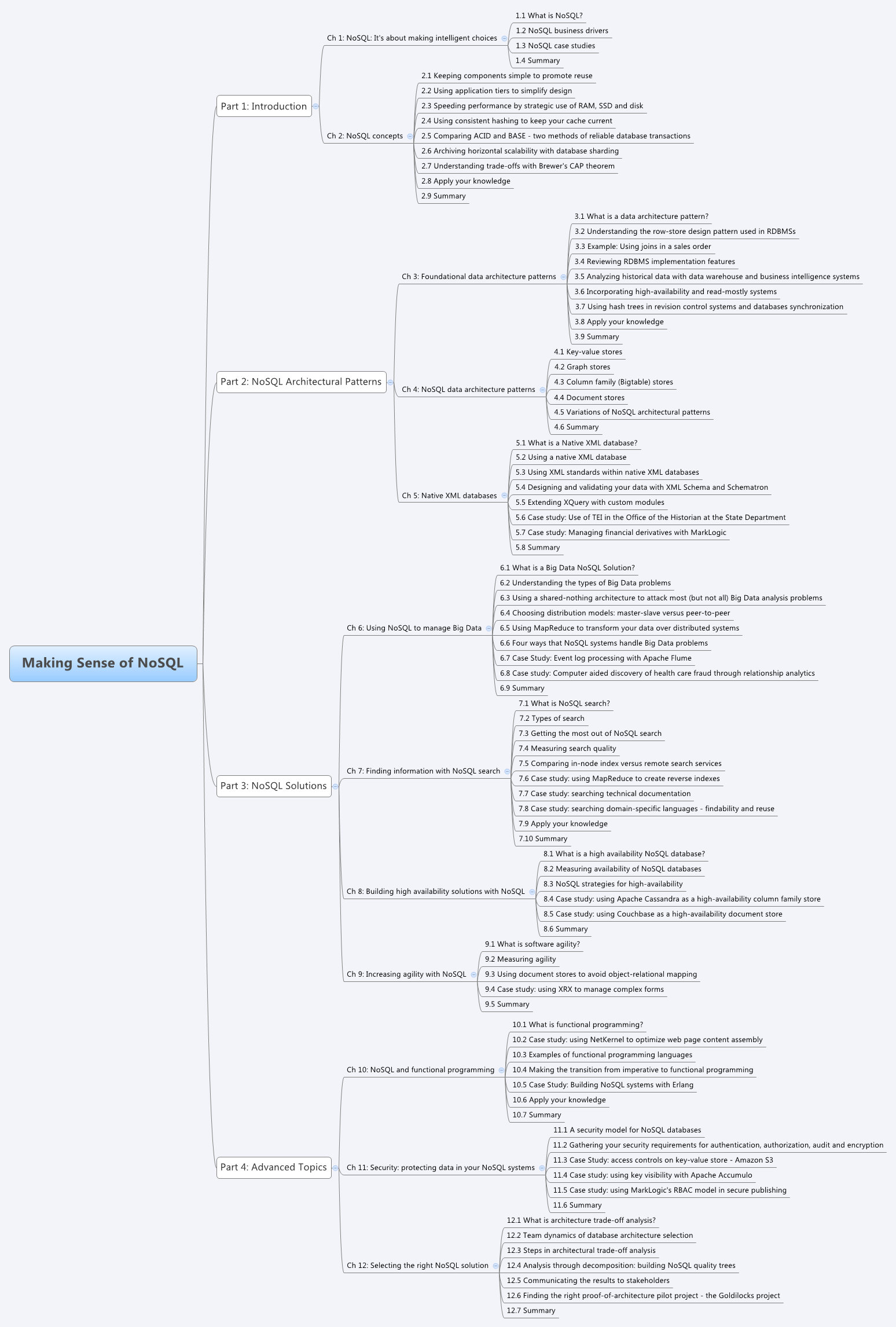
You can also convert the table of contents into an Mindmap file and open the file in FreeMind or XMind.

Here is an example of the book rendered in XMind.  NoSQL Book MindMap

Glossary of terms reports

Our book puts a focus on the terminology used in the NoSQL movement. We try to create precise definitions of all the terms we use and discuss the variations in definitions in different NoSQL communities.  I use these reports to list each time a term is first introduced and make sure that we have a formal definition in the Glossary Appendix at the end of the book.

Glossary Term Report Showing Glossterm IDs and Definition Status

There are also other miscellaneous reports listing the introductory chapter quotes, lists of comments by reviewer (extracted from PDF using Apache Tika), and various tools to help us gauge the completeness of each chapter.

Report Strategy

We created a central XQuery book module that had all the common functions such as $book:chapters, or  that returned a sequence of all book chapters or book:word-count($node) that returned a word count of a node.  I used the eXist-db database to store and execute the transforms.  After we created the module the templates could be quickly customized for each report.  We also used the oXygen XML IDE extensively and we want to thank George Bina for his support of our project.

I think that DocBook, oXygen, XQuery and eXist are ideal tools for managing the book creation process.

Saturday, September 24, 2011

The "Pathification" of NoSQL

In my consulting work I try to focus on the empowerment of the non-programmer to build and maintain their own web applications. This is not an easy task. There are many barriers, some political and some technical. But when a new Business Analysts or Project Manager can create their own metadata management tools and begin to tell others their story I have great job satisfaction.

My current best-practice is to teach non-programmers how to write XPath expressions into their data sets. I tell them that if they are committed to "knowing their data" that I can teach them how to write web-applications in a week or so. The trick is to give them a "template" CRUDS application (Create, Read, Update, Delete, Search) that they can just plug in their own XPath expressions to get the application to work. They don't need to know the thousands of features of XQuery and native XML databases, they just need to know their data, how to write some simple XPath expressions and where to put these expressions into the templates.

I call this process "Pathification", a word that is similar to "Simplification" and "Standardization" but it has a focus on only teaching a very small subset of the many possible tools and a focus on cross database standards like XPath. Once they feel confident they can create simple CRUDS applications in a few hours they are then highly motivated to continue learning XQuery, but on their own pace and balanced with their other job responsibilities like data governance and semantics.

Pathification is something that can happen because native XML database have many enabling technologies. They have WebDAV drivers that makes you database look like folders on your desktop. We have tools that automatically convert XML into HTML and XForms. We have subversion libraries that allow your form "save" to go directly into a version control system. And these tools continually get better and make it easier to empower novice users.

The NoSQL movement is a huge and diverse community. And many people have focused on areas such as scalability and the integration of different types of data into a single XML development environment. These are all great efforts and really move us in the right direction. But I think for us to make NoSQL into a true multi-vendor, multi-product development platform is to create more tools that empower the non-programmer. For people in the native XML world we have a great start. Standards like EXPath, new application packaging tools and XRX application repositories will continue to make it easier for non-programmers to reuse and share their applications.

What I would like to see (but I am not sure is possible) is both XML and JSON-centric system to start to come together and share their ideas on how to make this happen. Can JSON data-stores like MongoDB and CouchDB be "Pathified"? Can we create shared applications that work with both types of back-end systems?

If we do this right, I think the world will be a much better place. People will have more choices for managing both structured and semi-structured data and non-programmers will be able to take a spreadsheet or new data feed in a standard format and build a new web application that manages this data in just a few hours without having to depend on other programmers. I think of this as a system as easy to use as Microsoft Access(TM) but without the chaos: All data can be stored on centralized servers with REST service-oriented interfaces for every data set.

Please let me know your thoughts on these ideas.

Friday, September 24, 2010

McCreary's Law

I am just returning from a three-day conference on Enterprise Information Management. I was very pleasantly surprised to meet many other very smart and warm independent consultants that do metadata and EIM consulting. More posts about what they taught me will be coming.

But these conferences for me to constantly answer the same question over and over again. What do I do an why don't I use traditional RDBMS systems to store metadata? What I need is some strong statement that explains the core principal of the need for agility in metadata management. So in that context, I would like to suggest a law of agile software development. To give it a label, I will just use McCreary's Law for now.

McCreary's Law states the following:

The agility of any software project in inversely proportional to the square of the number of data transformations in the developer stack.

The number of data transformation in the traditional three tier-architecture (Web to Objects to RDBMS to Objects and back to web) is four.

The number of data transformation in the traditional three-tier plus XML web services is six, since web services are usually created by one transform from objects to XML and one from XML to objects.

The number of data transformations in XRX is approximately zero, since we could make an argument that XML to HTML is a 1/2 translation since the HTML and XML tags are different. Of course if you are not changing the order all XML can be styled with CSS which is not really a transformation. This gets around the problem of infinite developer agility if the denominator is zero.

This formula is not perfect and I am sure their will be modifications to it like adding a constant for training and IT resistance to change, but I hope people can use it to predict or explain their current development agility.

Thanks to everyone I met at the EIM conference that listened to my rants and have not discarded me as a complete metadata radical.

Wednesday, November 12, 2008

How to compile the eXist 1.3 build

I have been learning how to use higher-order functions in XQuery. I am using the eXist system to test this. To do this you will need to get the 1.3 build that there is no download for (yet). Here are the steps I used:
  1. Download fresh copy of eXist from svn via TortoiseSVN or Eclipse subversion subclipse plugin from the eXist SVN sourceforge repository:
    https://exist.svn.sourceforge.net/svnroot/exist
  2. (Confirm environmental variables are set correctly for JAVA_HOME and EXIST_HOME) To do this I use the Windows/Computer/Properties/Advanced Settings and check it with the SET command at the CMD prompt. The result looks like this:
    JAVA_HOME=C:\Program Files\Java\jdk1.6.0_10
    
    My Eclipse workspace is just "C:\ws" and I created a project called eXist-1.3 so the path name I used for EXIST_HOME is:
    EXIST_HOME=C:\ws\eXist-1.3dev
    
  3. Open the DOS cmd prompt, cd to eXist directory
  4. type in "build.bat"
  5. Type in "build.bat -f build\scripts\jarsigner.xml"
It took just 1 minute and 6 seconds for the main build to run on my 4CPU system with 8GB of RAM even though it is running Vista. Then I just ran the start.bat in the bin directory. eXist was then running on http://localhost:8080/exist. I had to use the new WebStart admin tool on the admin section of the eXist web page to change the admin password. Thanks to Joe Wicentowski at the US Dept of State for helping out!

Tuesday, May 27, 2008

XRX: Simple, Elegant, Disruptive

I recently started writing for O’Reilly Media. I posted an article on XRX. Here is the link:
http://www.oreillynet.com/xml/blog/2008/05/xrx_a_simple_elegant_disruptiv_1.html
We are just getting started moving to a new MoveableType (MT) system so not all of the features (like keywords and feedback) are working.
If you have problems commenting on the site, please feel free to post your comments here.
Here is a comment from Arun Batchu:
An elegant introduction to an elegant architecture, Dan. Thank you. The essential takeaway from what you describe is the exploitation of XML from one end to the other end - especially from the Developer's perspective, for, how XRX actually manifests in runtime could be left to implementation technologies. Thus the logical architecture of XRX could be realized by a few variations of concrete technology - which is great. The XForms could be realized by XForms server technology (such as the excellent Orbeon stack), the ReST could be realized by any middle tier and the XQuery could be realized by an XQuery engine (such as Data Direct) that may actually be driving any one or a combination of datastores (XML, SQL, file system or ...) . The symmetrical and consistent leverage of XML as a data model from creation to transport to rest and back eliminates a whole lot of wasteful work. Like you point out, XPath is one of the most powerful query systems I have encountered; you can pack so much in so little and reuse it across the board with little if any change from the drawing board to production. In such a system as you describe, a business rule expressed once can be reused anywhere - from one end-to-end , however long the travel, as long as the architecture is XRX, like you have described. Thanks for expressing it so well. A few of your readers will not get it - it is one of those things that once you experience it, you are left wondering why this did not happen before. Oh, well!

You are welcome! Thank for your feedback Arun!

Sunday, January 06, 2008

XRX and MDA

Summary

This posting describes how using three technologies (XForms, REST and XQuery or XRX) you can dramatically transform your organizations development methodology. You can move true model-driven architecture (MDA) that dramatically reduces the temptation to duplicate code.

In January of 2007 I was working on a complex real-estate forms project for a state agency in Minnesota. Our job was to get 87 counties across the state of Minnesota to agree on the over 250 data elements that describe real estate transactions. We had spend months developing a complex XML Schema and web forms with over 50 one-to-many relationships. And out next task was to be able to save the form

data into a structure that could be quickly queried by any of these 250 data elements. But the prospect of "shredding" the documents up into 50 distinct SQL INSERT statements and then reconstituting the documents with 50 distinct SQL SELECT statements was going to require doubling our small team of four to at least eight developers. We didn't have the budget or schedule to do this. After chatting with Kurt Cagle he suggested saving the data to a database that supported XQuery. Both the open source eXist native XML database and our corporate standard, DB2 supported XQuery. It turned out that we could indeed save the entire document with a single command and still perform complex queries on any element in any document. Our project could proceed with a small team and stay on schedule.

And then an interesting thing happened. Our team started to understand that if we saved additional metadata in these native XML data stores we could accelerate our project even further. Every pick-list in every form could dynamically call REST-enabled web services to get their values. XML Schemas could be stored in the databases and be queried. We had found a simple and elegant solution to the pervasive problem of where to store the model in a model-driven development project.

In the past I had been on large teams of developers that attempted to use model-driven development. But although we started out each project with idealistic goals, each time we were faces with a classic option: copy, paste and edit the model or write a transform. The copy and paste solution was quick but it would have to be redone each time the model changes. The transform took longer to write but then could be rerun each time the model changed.

Like most developers, I always was over-optimistic that I had done my homework and done accurate and detailed modeling of the problem. I thought the models were stable and would not change very often. And I was almost always wrong. Models do change and sometimes in totally unexpected ways.

But by storing our models in a native XML database an interesting started to happen. We could quickly transform the models (stored in XML) into other artifacts with simple XQueries. It became far less tempting to commit the sins of copy/paste/edit when it only took five minutes to create another transform. And most remarkably, each of these transforms was another REST enabled web service that could be reused by many web clients or other development tools.

So how do you get started? You might try the following steps.

  1. Download the exist database from http://www.exist-db.org
  2. Use a WebDAV interface and copy some XML Schema documents into a collection
  3. Write a few small XQuerys that pull metadata out of your XML Schemas. For example pull out all the enumeration values out of an element.
  4. Use those XQueries to drive some aspects of your development such as an XForms selection list.
  5. Compare the amount of code you wrote with any other MDA system. If you don't have at least a 10 to 1 savings I would be very surprised.

What do you think? Do you have a more efficient way to query your model? Let me know!

- Dan

Monday, December 17, 2007

And the Winner is: eXist-db.org My Award for the Most Innovative Product of 2007

As the year starts to come to a close we often take some time to look back at the year and look at the innovations that we have seen that have changed our worldview. I can think of many things that have had a large impact on me: The FireFox XForms extension, discovering the beauty of a well-designed REST interface, the mule enterprise service bus, Yahoo pipes and microformats all come to mind.

But after careful consideration I have to hand my award out to the most innovative application of the year to me to the eXist database/web server. This application constantly amazes me with what I can do with it. If you have a Java JVM on your desktop it only take a few minutes to get it running. Hit the startup script and you have a web server running on localhost:8080. Open a WebDAV browser and drag-and-drop you files and folders and away you go. With eXist I can easily setup a full enterprise metadata registry on a laptop in under five minutes.

The power of eXist comes from its use of the XQuery engine. Any well-formed XML file that is added to the system gets instantly indexed and can instantly be searched. That means that 10ms after you hit the "Save" on your XForms you can see the data appear in XQuery reports.

But the "Secret Sauce" of eXist rests in it's use of a lightweight Jetty web server with a remarkably integrated REST and WebDAV interface. This means that every XML file…is a static web service. This means that every XQuery that returns XML…is a dynamic web service that you can parameterize. This means that you can be writing your first web services in fifteen minutes that can be grabbing data from a dozen different XML files and quickly serializing the results out the wire. Enterprise mash-ups at your fingertips. Very little programming is done other then selecting data. Just like it should be.

eXist technologies are going to start to have a big impact once XForms/REST and XQuery (XRX) web development matures. I predict this is going to happen in the next three years. An although IBM, Microsoft, Oracle and many others are supporting XQuery in a big way, they don't yet have the really smooth integration with next-generation XForms-driven clients. You still need teams of AJAX, JavaScript, Java, .Net and SQL programmers to build simple web services for rich client interfaces.

I must admit it took me a little while to really understand how the simplicity of the interface really rocked my world. Just swap out the world "rest" in the URL and replace it with the word "webdav" and you go from a data browser to a file system that works with every copy/cut and paste operation of the file system.

It is also interesting to note that this product did not come out of a Bay Areas startup, it didn't come out of Google Labs, it didn't come from Microsoft or IBM. From what I can tell the initial version was pretty much written by a single guy in Germany, Wolfgang Meier. It think this shows that there is still room for true innovation by a single individual in this world. Although eXist now appears to have a great team of people behind it, it shows that a single person with a clear architectural can put the right pieces together really can make a difference in the world. Our teams could not have been as productive with XForms if we didn't have a clean and elegant tool like eXist behind our forms. I know that XRX innovators will no be able to stand on Wolfgang's shoulders and build incredible applications.

Thanks Wolfgang! Your labor of love is growing up!

Friday, December 14, 2007

Introducing the XRX Architecture: XForms/REST/XQuery

At the XML 2007 conference there were many people that seemed to have independently discovered that if you combine XForms/REST and XQuery you can create a software development environment that circumvents the need for middle tier objects and conversion to and from relational databases.

The conference also had a great deal of discussion of how XForms is a great architecture but as Elliot Rusty Harold pointed out, we need something to happen for XForms to replace things like AJAX. Although Rusty did propose a few interesting ideas (like getting XForms built into FireFox) I feel what we really need is a contagious meme. And I think it goes beyond XForms. What we need is an easy-to-remember and easy-to-communicate name for a collection of great ideas. For example there are few books that have the word XMLHttpRequest in it. But there are hundreds of books with AJAX in the title. Once the word AJAX was coined the meme started to spread. The world was waiting for the "sticky" label behind the concepts.

What XForms needs is a label around the collection of ideas that makes XForms really give you an order-of-magnitude improvement over other web development architectures. I would like to suggest that we get behind one "label" that brings many of use under one big tent. I would like to suggest we use "XRX".

XRX to me would stand for the ideas behind XForms/REST/XQuery web applications. But if people are using XHTML as a container for XForms you could use XHTML/REST/XQuery. Just spare use the "J" which is associated with a hard-to-use language for über geeks.

You could also use XRX for the format of the data in the client and on the server. In this case it would be XML on the client (in the XForms Model), and in a native XML database that supports a REST interface.

We can still build awesome tools and frameworks that make the XRX architecture really fly. IBM Workplace Forms Development tools, Orbeon Presentation Server, Kurt Cagle's new frameworks that use the eXist native XML database, and the hundreds of other XForms development tools all fit into the XRX strategy.

But if we make XRX into a "big tent" strategy we can also include XQuery on the server as part of the architecture. This would include people like Jason Hunter at MarkLogic. Jason is an experienced Java developer that has started to move away from Java on the server and toward XQuery because of its richness. And I could not agree more.

I have been reading the book The Tipping Point: How Little Things Can Make a Big Difference by Malcolm Gladwell and trying to apply the ideas in it to the adoption of XForms and XQuery. I think that the book has many example of how a careful packaging of the ideas behind a contagious meme can make ideas spread like widefire.

So when we hear the term "XRX" we want to have the following concepts come to mind:

  1. A web development architecture with a 10x productivity improvement over traditional JavaScript/OO/RDBMS methods
  2. A development architecture based on international standards that is designed to minimize the probability of vendor-lockin
  3. An architecture that gives a rich user experience without creating mountains of spaghetti procedural code on either the client or the server
  4. A system that leverages the REST architecture to take advantage of high-performance and simple interfaces using web standards
  5. Portability on both the client and the server using a variety of forms players and XQuery databases
  6. The option of avoiding costly shredding (and reconstitution) of complex XML documents into RDBMS tables
  7. A community of standards/tools and a "complete solution" ecosystem that can give you a proven ROI on your IT investment

I don't expect everyone to buy into the XRX meme ideas. Everyone has their own favorite tools/standards and acronyms. But everyone that was at the XML 2007 conference could feel the excitement in the room at the XML presentations. Now we need to give that excitement a name and see if it sticks. Hopefully a few years we will be able to walk into a bookstore and see a bunch of books with "XRX" on the cover.

What I now need is for people to start to test the XRX meme and see if it slicks. Let me know what works and what does work. Send me your 30-second elevator pitch. How big should the idea tent be? What do we have to do to get more people in our tent? What evidence (case studies), example programs and resource do we need to convince the world we have seen the light …and its so elegant and beauty to will keep us from ever going back to the stone age of web development.

Saturday, December 08, 2007

Impressions of XML 2007 in Boston

I returned from the XML 2007 conference in Boston with my head spinning about all the new developments with XForms and XQuery. The conference was three days long and had between three and five tracks going concurrently. My impression was that there were about 400 people there.

Here are some of the highlights for me.

XForms appears to be getting lots of traction. The XForms sessions were all packed with standing-room only in most of them. The presenters we passionate that the combination of XForms, REST and XQuery has had a huge impact on their projects and may soon impact the rest of the development world.

Microformats are definitely starting to make huge strides where Metcalf's Law will start to kick in. The existence of 450 million tags and five FireFox microformat extensions indicate that within a year it will be just part of web publishing best practices. Even Microsoft is said to be supporting Microformats in IE 8, just a few years from now.

Taylor Cowan (who works for Sabre) gave an excellent presentation on how Microformats can be extended into the travel space with an Atom based format for publishing trip ideas. His use of Atom and semantic web technologies was right in line with my vision of how personalized agents are going to leverage microformats.

John Boyer's demo of IBM's Workplace Manager showed that you can now purchase top-shelf XForms GUI design tools that does not lock you into a proprietary vendor solution. I hope the people from Microsoft, Adobe, FairIsaac, Altova, Google GWT and other vendors take notice. Locking your users into a Java or JavaScript client is no longer an acceptable strategic option for developing web applications. Wake up everyone! Are you listening? We have a standard that works and lets now start building more great tools that use this standard. XForms is the only system that is creating as John puts it "Order of Magnitude" increases in developer productivity.

Mark Birbeck's Sidewinder demo showed that XForms is breaking out of the browser an on to the desktop. Showing web and iPhone web pages directly in desktop widgets was a great demonstration of the power of XForms.

Kurt Cagle's presentation about problems with programming with the fragile DOM model in JavaScript was interesting in its format. The presentation was actually an XForms application running on eXist. Kurt "eats his own dog food" on the client and the server! I am humbled by the man.

Jason Hunter from MarkLogic (an XML database vendor) gave an nice demo of the MarkMail.org application and showed that, yes, XQuery databases really do scale to the terabyte range. He has about 4 million e-mail messages indexed and you can do combinations of database and text searches in a few seconds. In other words a demonstration of how real-world analytics comes to XQuery. I also found out that MarkLogic is free if your database is under 100MB. Perfect for 10MB of metadata in a metadata registry.

The people from IBM research labs appear to be starting to take the XForms MVC architecture and really run with it. We saw some very interesting presentations on how future standards for data driven XML Application Components (XACs) and State Chart XML (SCXML) might be used in the future to make browser-based mash-ups easier. Componentization, composition, customization and reuse are all part of this architecture and it would not be possible without XForms MVC architecture. Hopefully Charles Weicha from IBM research will post his slides so you can see more.

Norm Walsh also talked about how the new XML Pipeline standard (XProc) is starting to take shape. Even though the standard is still in working draft there are already at least five implementations of the standard. This single standard could have more impact on the shape of server-side processing then any other standard coming out of the w3c. Integrating this into XQuery-based application servers seems to be the next step.

The eXist database also seemed to clean up all the open source native XML database talks. eXist was mentioned in over a half-dozen presentations and there were no other native XML databases even mentioned in the presentations I attended. It is not surprising that eXist is now the top hit on Google when you search for "XML database".

One of the most interesting presentations that I did not get a chance to see (but I did talk to the presenter afterwards) was Thomas White's presentation on using XSLT in the browser to get a 10x speedup in form rendering. It turns out that implementations of XForms players like FromFaces use heavyweight JavaScript objects in the browser. Thomas has found that a donkey cart can be turned into a sports car by implementing an in-browser XSLT centric event scheduler. If his architecture is implemented we could see vastly better XForms players in the future. Lets all hope that Thomas's architecture comes to the XForms world sooner than later.

I did not attend any of the XML publishing tracks. But from the titles it appears that the Darwin Information Typing Architecture (DITA) standard is a hot topic. Presentations on using XSL-FO and CSS for book and other print publishing were also on the agenda.

I also did not attend too many of the XML in the Enterprise tracks. There were good presentations on XML accelerators, security and mining XML Schemas.

I am disappointed that the conference organizers did not do anything to require that people post their presentation on the web site before their talk. There were many very interesting presentations that could have a larger impact the world and the sloppiness of people not publishing their slides seems to be a little unprofessional. There were some people that just brought their digital cameras and took pictures of each slide. Smart.

In summary I think that the conference had two types of people:

First there were people that had not done extensive work with XForms. The first group I call the "evolutionary proceduralists". Theses were people that were trying to beat the dead horse by patching the old-style procedural web application architecture with JavaScript, JSON and AJAX hacks. They seemed to spend a lot of time arguing about the merits of JSON vs. XML as a data transport syntax.

The other type were "the enlightened innovators". People that have seen the real world benefits of dumping object middle-tier stacks and relational databases and going with a pure declarative approach to solving business problems based around XForms/REST and XQuery. These were the people that are going to lead innovations in application development.

I was also impressed how a large percentage of XML innovations came from outside the US. I attribute the fact that some of the best presentations came from the UK to be the "Michael Kay" effect.

Beauty is in the Eye of the Beholder At one of the XForms sessions a young Ruby advocate stated that he thought his Ruby code was "beautiful" but he did not himself think that XForms code was "beautiful". Most of the people in the audience agreed that XForms was beautiful but like any new language, it takes getting used to. Beauty is the process of your visual cortex recognizing familiar patterns and signaling your pleasure centers. If you have never read Japanese then the most profound Haiku written in the most beautiful script will not have beauty.

XForms/REST/XQuery to me is indeed beautiful. Its beauty comes from its ability to quickly map real-world requirements into working systems with high fidelity. No other system in the world approaches its elegant architecture. And after XML 2007 I realized I was not the only one that had independently reached this conclusion.

Thursday, October 18, 2007

When XML Schemas Imports Become XQueries

For the last five years I have been using a XML Schema design process that I learned from the people at Georgia Tech Research Institute as part of my work with GJXDM and the NIEM. This work has strongly been influenced by Jim Heldler who co-wrote the Semantic Web article with Tim Berners-Lee. Although GTRI wanted to use RDF (graphs) to represent the exchange data they had to settle on using XML and XML Schemas since those technologies were widely used by most criminal justice agencies already. They compromised by still using a striped model within the XML Schema driven structures.

Creating an exchange documents starts with creating a metadata registry of all the data elements used in a family of XML Schemas. A shopping-cart-like tool is used to select a subset of the data elements. These data elements form a "wantlist" of data elements. The checkout process creates a zip file that when uncompressed creates a set of XML Schema file that you import into your constraint schema.

This process is an order-of-magnitude to use than before the subschema generation tools were created by GTRI. The subschema generated by the checkout process not only included the XML Schema type definitions but also all the data types that they depended on. The metadata registry had an internal dependency list that it maintained and so if you needed just ten data elements but they depended on then other data types you got all 20. you didn't have to manually figure out what additional data types to include.

I adopted the GTRI shopping-cart process to include adding a "subscribers list" to each of my data elements used in local metadata registries and local XML Schema creation. I used a large, complex and brittle ant script to update all the imported files for each XML Schema we were developing. But this could not easily be done during a requirements gathering meeting.

In the past we have viewed this subschema generation as a process of interacting with a web application that creates a set of files. One of our first insights is that this process is in fact just a transformation of the metadata registry based on the rules created by a wantlist and the dependency graph. It does not have to be a manual "batch" process.

In a recent blog (Metadata Web Services) I pointed out that tools like eXist and XForms allow us to store metadata in XML format and allow it to be easily updated by BAs and SMEs and queried using languages like XQuery. One of the great realizations I had on my last project was that XQuery has a simple construct that allows you to "chain" web services. The argument to the doc() function is just a URL. If that URL points to a web service that returns XML you can easily build composite web services. Web services that are transformations can be chained together. This allows you to start using enterprise integration patterns to build reusable services at a very fine grain.

Putting these facts together it has occurred to me that the ultimate goal of the metadata registry process is to allows new data element definitions and enumerated values to be changed during a XML Schema design process. We should be able to change a definition, hit the "save" on the XForms application that edits data elements and then just refresh the generated subschema. The refresh process must call a XQuery that calls web services that analyzes the dependency graph and updates new data elements imported into the XML Schema.

What this does is helps us get to the goal of updating the a model quickly and generating new artifacts directly from the model. This is part of the overall model-driven development process. The artifacts we create include XML Schemas, instance documents generated from the XML Schemas and XForms applications to view and edit the documents. This faster turn-around time allows our users to quickly see if their definitions and enumerated values are being precisely captured and used to create actual systems.